


Last week I attended an eye opening conference at the EPFL in stunningly beautiful Lausanne, Switzerland. It was a breath of fresh air and I left feeling like the scientific community was finally ready to listen to what we patients have to say…


During the conference I was also introduced to two people who have, in the short time since, helped shaped the way I think about neurodegenerative diseases. The first was Judith Steen, a Harvard professor and a proteomics wizard who studies large populations with these diseases and showed that protein aggregation can occur through multiple biophysical pathways triggered by different insults. Ozgun Gokce is from the University of Munich, he identified the role of T cells in neurodegeneration and demonstrated for us a powerful new technology transforming our understanding of biology called spatial transcriptomics. These omics approaches interfaced with detailed patient data provide molecular connections to pinpoint the ontogeny (the point in early development where something begins) and progression of these diseases – thus generating novel ideas to prevent progression.
After the conference the three of us went to dinner and talked and talked and talked about all things Neurodegenerative Diseases. Ever since we have discussed at length how data driven research leads to the identification of new ideas and hypotheses including the role of multiple insults and how the peripheral immune system can be triggered in neurodegenerative diseases.


I have also managed to spend time with Markus Britschgi, a brilliant immunologist at Roche who I have known for years and someone who always reminds me just how challenging it is to turn any of these ideas into something that might one day be consumed by human beings.
All of which led me to re-examine a paper I wrote four years ago with Prof. Patrik Brundin, Dr. Michaela Johnson, Prof. Lena Brundin, and the now sadly deceased Prof. Viviane Labrie titled Triggers, Facilitators and Aggravators: Redefining Parkinson’s Disease Pathogenesis…
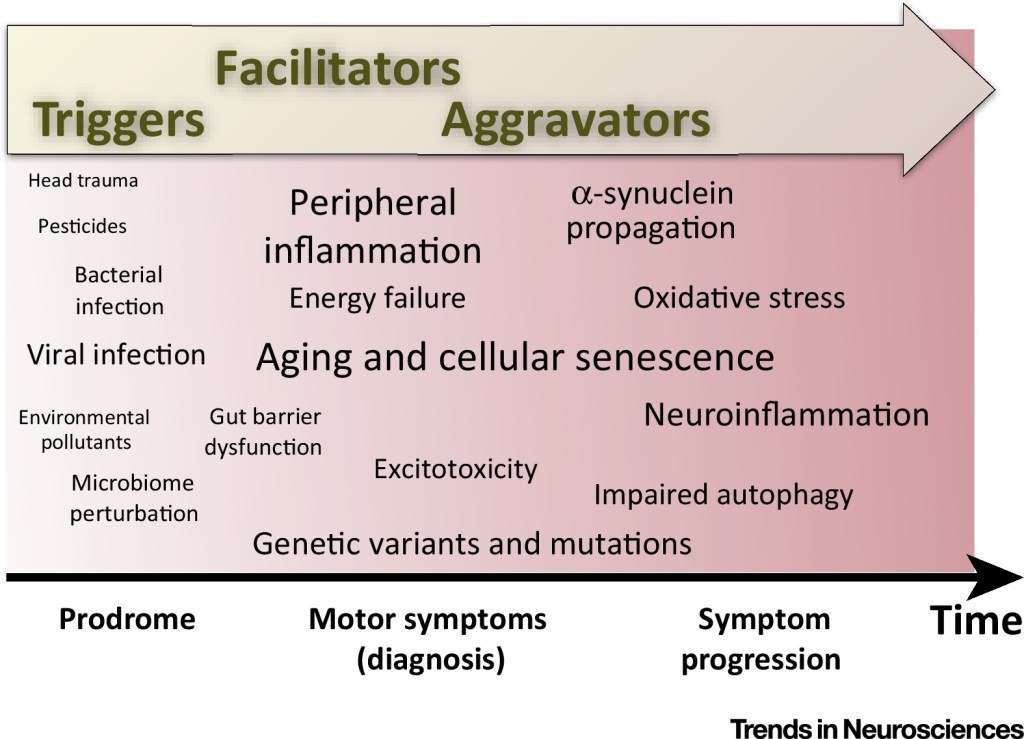
In the intervening years I have learned a lot about this sequence of events and I think an update is now in order. For one, what we applied to Parkinson’s Diseases can likely be applied almost across the spectrum that we call Neurodegenerative Diseases. Also, as you’ll see below, some of the categories no longer make much sense to me, and others have been added as we better define just what these diseases are…I think:
Triggers (likely 10-20 years before symptom onset): First, there is an insult, most likely a viral infection or a traumatic brain injury or a bad case of irritable bowel syndrome. But those alone are likely not enough and probably require the presence of some (likely genetic) susceptibility factors.
Inflammation – T/B cells then infiltrate the target area through any number of pathways that connect the brain with the immune system and induce all sorts of damage. This would then likely be followed by microglial activation, glial scarring, and oligodendrocyte/myelin/white matter degeneration. Though there is one particular brain region I would like to emphasize for Parkinson’s Diseases called the Choroid Plexus. As this paper shows, it is the most likely area for infiltration in PDs as this is the point where the blood brain barrier meets the dopamine circuitry. (Thank you Megan for pointing this out!)
Cell Dysfunction – For a variety of reasons, whether because of mitochondrial dysfunction, lysosomal storage damage, straining of the endoplasmic reticulum, the retracting of synapses, epigenetic markers running a mess etc. etc. the cell starts to become dysfunctional.
The Tipping Point: When a single cell dies no one notices. There is no single cell in any of us that is that important. Besides, when damage is isolated within or near any one cell, our bodies have plenty of ways of dealing with the damage just fine. Our problems are systemic and occur when enough cell dysfunction happens within a circuit such that the entire circuit is disturbed. We are an electrical storm of activity brought to life by biochemistry but it’s the electrical activity that allows us to be. When damage within a circuit passes an unknown tipping point, symptoms emerge.
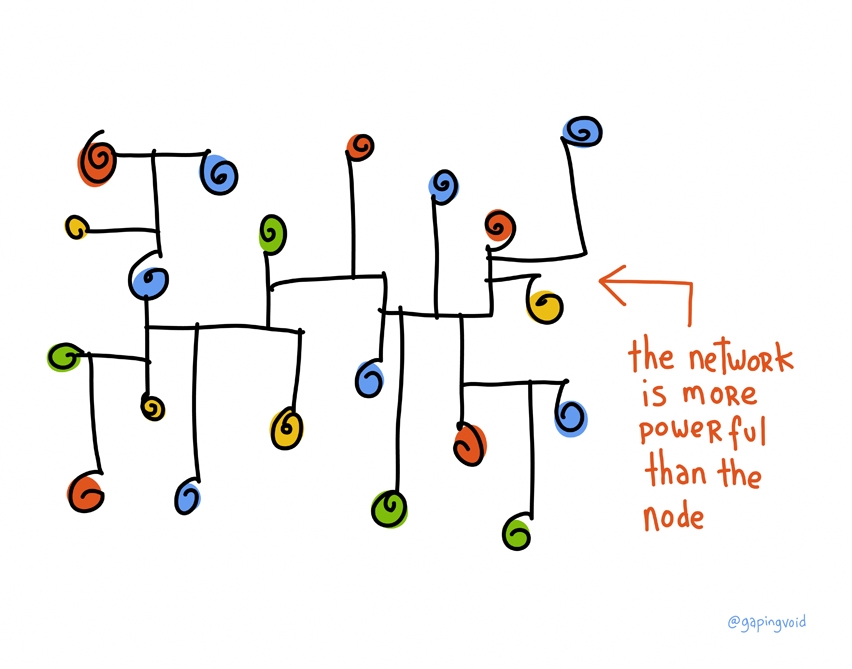
That last part seems to me, as a patient, to be the most important. I find it odd that so much relative attention is given to cell dysfunction and so little is given to answering what are the key questions we patients need to know – How much cell dysfunction is required to reach this tipping point and what can be done to slow and/or stop that? For centuries, it seems, biologists have been fixated on understanding the causes of intracellular dysfunction, but it is the networks that matter and it is the networks that should be studied so that we can figure out how to protect them and stop or slow symptoms from emerging.

That then leads me to three final points, for now 😉
- I am just one example, which by itself is kinda meaningless but I am wondering if we started to collect more such patient stories, like mine right below, might we get a clearer picture of these diseases?
Using myself as just one example…my GBA mutation combined with my migraines as a kid, my EBV infection I got in my late teens/early 20s, and a couple bouts of IBS at the same time, were the likely trigger that sparked my T/B cells(unique to me) to come into my basal ganglia (likely through the Choroid Plexus) which resulted in the selective gobbling up of my dopamine circuitry.
(If any other patients out there are willing, please put any thoughts you might have about how, when and what sparked your disease in the comments below. If we get enough it could lead to novel insights into mechanisms of diseases and provide new means to target these diseases.)
- What can be done today to help? Well, if there is any truth to the above, it seems like we need to try and dampen the immune response as early as possible while doing what we can to mitigate damage done to the circuits or figure out ever more clever ways of replacing the function of those circuits. However, we need to study the specific network dysfunction taking place within each patient and start thinking of tailored solutions to each problem without weakening the immune system against future pathogens.
- Also, we need objective markers that we can then combine with these real world hypotheses so we can actually test whether or not these things are working in large groups of people. But, thanks to companies like Rune Labs, we may soon have some of those markers…

Well, those are my thoughts, for now. Wanted to give a big thanks to Prof. Hilal Lashuel (pictured way above) for putting together an incredible conference last week and setting the tone early by letting the patients have the first say. Hoping more conferences will follow his lead and do the same. (cough, cough…MDS…cough, cough)
Finally, I also wanted to highlight a video that I was allowed to shoot while at the EPFL featuring Prof. Henning Stahlberg where he gave a brilliant overview of all the latest advances in cryogenic electron microscopy technologies that have likely done more to transform our understanding of the micro world around us than any other tech we have…
